✨ This article was AI edited. Editorial responsibility: WhatIsKratom.net.
Produced with AI. This article was artificially generated. Editorial responsibility: WhatIsKratom.net.
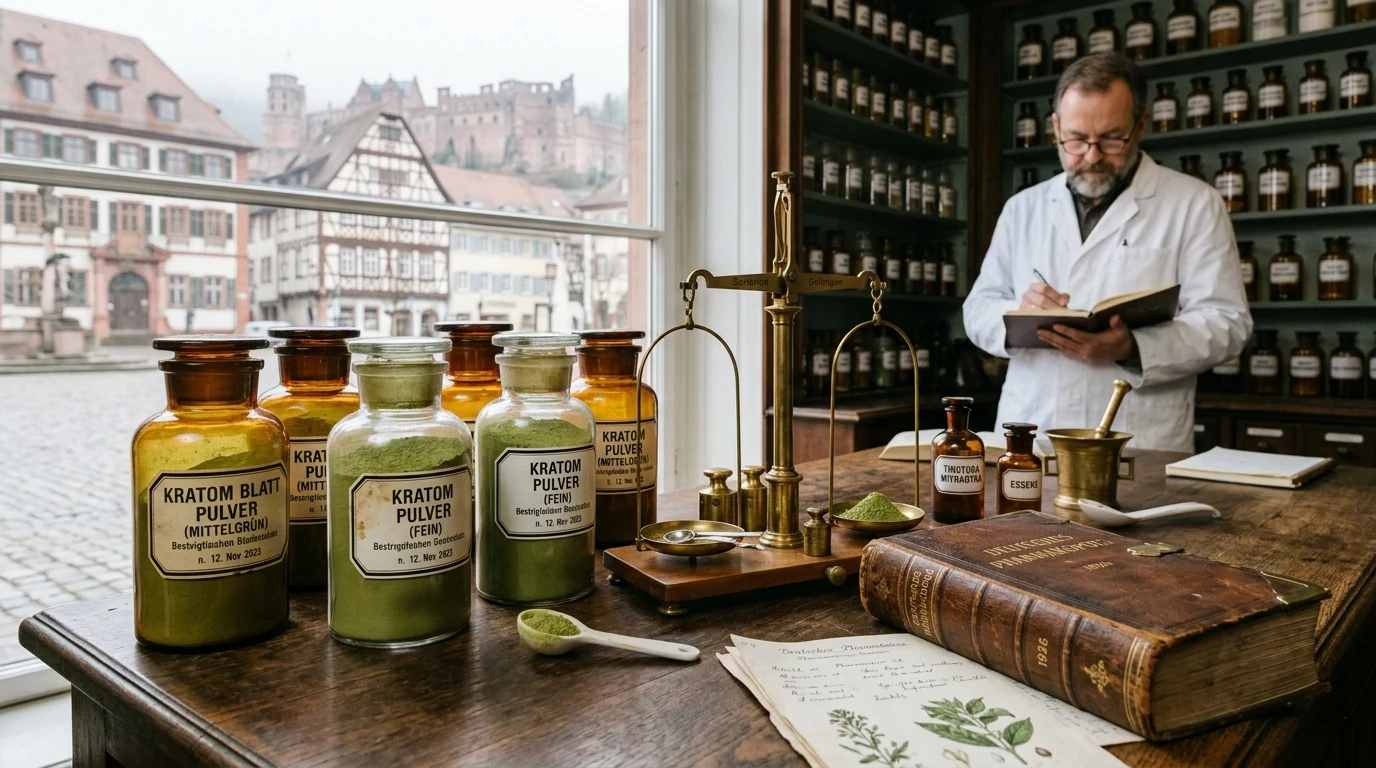
Kratom in Germany is completely legal to possess, purchase, and import for personal botanical research and technical applications under German law. While Mitragyna speciosa is not scheduled under the Narcotics Act (BtMG), vendors cannot market it as a finished medicinal product (AMG) or approved novel food, leading German distributors to sell compliant, lab-tested powders labeled for painting, soap crafting, and botanical display.
Germany represents one of Europe’s largest, most established consumer markets for ethnobotanical specimens. However, navigating the German regulatory system requires distinguishing between criminal narcotics laws and administrative commercial marketing codes enforced by the Federal Institute for Drugs and Medical Devices (BfArM).
In this comprehensive guide, we unpack the legal standing of kratom across Germany, analyze vendor quality benchmarks, examine German customs procedures, and outline safe, responsible botanical handling practices.
The German Legal Classification: BtMG vs. AMG
To understand the exact legal position of Mitragyna speciosa in Germany, two foundational statutes must be examined:
1. The German Narcotics Act (BtMG – Betäubungsmittelgesetz)
Kratom, mitragynine, and 7-hydroxymitragynine are not listed in Annexes I, II, or III of the German Narcotics Act (Betäubungsmittelgesetz). Consequently:
- Possessing kratom in any quantity is completely non-criminalized.
- Purchasing, trading, and gifting raw botanical foliage carries zero criminal penalty under narcotics statutes.
- There is no controlled substance scheduling applicable to Mitragyna speciosa on a federal level.
2. The German Medicines Act (AMG – Arzneimittelgesetz)
While completely legal from a criminal perspective, commercial distribution is heavily governed by the German Medicines Act (Arzneimittelgesetz):
- If a vendor markets kratom with explicit therapeutic claims (e.g., pain relief, anxiety reduction, or opioid withdrawal alleviation), German administrative courts treat the product as an unapproved medicinal product (Präsentationsarzneimittel), which violates the AMG.
- Similarly, the European Union Novel Food Regulation prevents marketing kratom as an authorized dietary food or beverage ingredient.
- To operate with full legal compliance, reputable German vendors package their products as raw botanical materials, natural dye pigments (Farbstoff), or incense, with clear warnings stating: “Nicht für den menschlichen Verzehr bestimmt” (Not intended for human consumption).
Compare the German regulatory model to other regions in our guide on Kratom Regulations and Legal Status Across Europe.
German Vendor Quality Benchmarks: What to Look For
Because kratom is sold in Germany without consumer dietary labeling, buyers must verify product purity through independent analytical testing. Germany boasts exceptionally rigorous analytical chemistry laboratories; reputable merchants take full advantage of this infrastructure.
| Quality Benchmark | Compliant German Vendor Standard | Substandard / Risk Profile |
|---|---|---|
| Alkaloid Assay (HPLC) | Full panel documenting mitragynine (1.2%–1.8%) and 7-OH (<0.04%) | No lab data; unknown or artificially spiked alkaloid levels |
| Heavy Metals (ICP-MS) | Strict compliance with German Apotheker standards (Pb, Cd, As, Hg) | Excessive lead or mercury from contaminated tropical soils |
| Microbiology | Clean screening for Salmonella, yeasts, molds, and coliforms | High pathogen load from unhygienic traditional open-air drying |
| Packaging | Multi-barrier UV-sealed kraft foil pouches with batch lot numbers | Clear unsealed plastic baggies subject to UV oxidation |
For an overview of preparation differences and bioavailability, review our analysis on Kratom Powder vs. Capsules vs. Tea.
Shipping, Logistics, and German Customs (Zoll)
For residents ordering kratom within Germany or importing from neighboring EU member states:
- Domestic Shipments: Orders sent via DHL Paket or Hermes within Germany are standard domestic parcels and arrive within 1 to 2 business days without regulatory intervention.
- Intra-EU Imports: Under European single market rules, ordering from Dutch, Austrian, or Czech vendors is legally permitted. However, German customs (Zoll) occasionally conducts spot checks; if products arrive in packaging with overt medicinal claims, shipments can be returned or held for administrative review under AMG provisions.
- Non-EU Shipments (Southeast Asia): Importing directly from Indonesian farmers carries high risks of customs detention, import turnover taxes (Einfuhrumsatzsteuer), and phytosanitary inspection rejections. Buying from established European importers is significantly safer.
Popular Strains in the German Botanical Market
German botanical enthusiasts typically categorize Mitragyna speciosa by geographical origin and harvest maturity:
- Green Malay (Grünes Malay): Known for vibrant emerald coloration, high chlorophyll density, and a sustained, balanced alkaloid plateau.
- Red Bali (Rotes Bali): Harvested from mature old-growth trees and dried under sunlight to promote deeply relaxing secondary alkaloid transformations.
- White Maeng Da (Weißes Maeng Da): Characterized by rapid morning vitality, mental sharpness, and high energetic resonance.
Discover the science behind vein pigmentation in our definitive guide on Decoding the Color Spectrum of Kratom: Red, Green, and White.
Frequently Asked Questions About Kratom in Germany
Is kratom illegal to possess in Germany?
No. Kratom is not a controlled substance under the German Narcotics Act (BtMG). Personal possession, purchase, and storage are completely legal throughout all 16 federal states.
Can German doctors prescribe kratom?
No. Kratom is not an approved pharmaceutical drug in the German pharmacopeia, meaning it cannot be prescribed by medical practitioners or covered by health insurance (Krankenkasse).
Why is German kratom labeled “Nicht für den Verzehr”?
Vendors label kratom as not for human consumption to comply with the German Medicines Act (AMG) and EU Novel Food regulations, allowing legal commercial sale as raw botanical dye or craft specimen.
Can I travel across German borders with kratom?
Entering Germany with reasonable personal quantities of kratom from another legal EU country is generally allowed. However, ensure packages are in original labeled packaging and avoid traveling into neighboring countries where kratom is banned (such as Poland or Denmark).
Get our latest guides, news, and insights highlighted in your Google Search & AI Overviews.